
Welcome readers old and new to this week’s edition of the Best of Econtwitter newsletter. Please submit suggestions — very much including your own work! — over email or on Twitter @just_economics.
Idiosyncratic favorites

^you see a first tweet like that and you know it’s going to be good
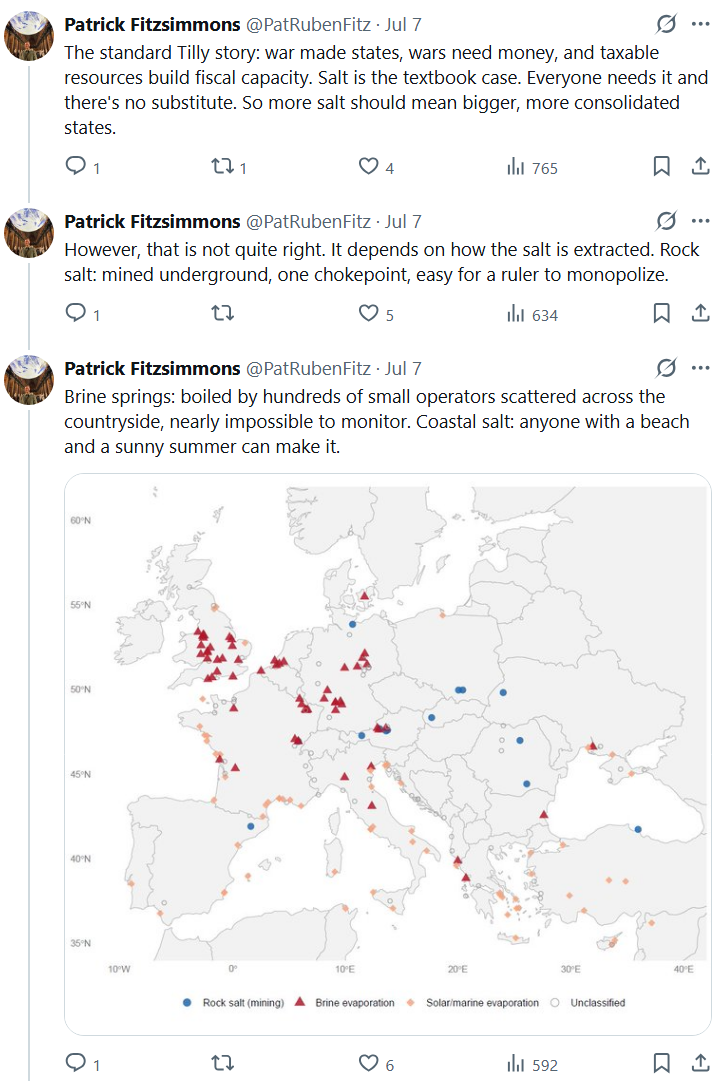


^you might have to chew on this one but it is JUICY

Jeffrey Lin@jeffrlin
On February 14, 1876, Bell & Gray each filed for a telephone patent. Such collisions were once routine — up to 1 in 20 patents triggered an "patent interference." Over the next 150 years, that rate fell by more than 98%. In a new paper, we explain why — and what it might cost.


4:03 PM · Jul 6, 2026 · 6.89K Views
1 Reply · 9 Reposts · 22 Likes
Jeffrey Lin@jeffrlin
US inventions have grown increasingly dissimilar. Using validated neural embeddings on 11+ million patents (1836–2023), we find a 1.5 standard deviation decline in pairwise similarity since 1836 — corroborated independently by a 150-year decline in patent interference rates.


4:03 PM · Jul 6, 2026 · 227 Views
1 Reply · 1 Repost · 5 Likes
Jeffrey Lin@jeffrlin
We develop a spatial competition model to explain spreading out: inventors choose locations in idea space. As the frontier expands and entry costs rise, they spread out — capturing larger territories, raising R&D investment and invention quality even as spillovers attenuate.


4:03 PM · Jul 6, 2026 · 129 Views
1 Reply · 1 Like
Jeffrey Lin@jeffrlin
Spreading out unifies two patterns that previously seemed in tension: the secular rise in breakthrough inventions and patent values alongside the well-documented decline in research productivity (Bloom+ 2020). Both are equilibrium outcomes of the same spatial geometry.


4:03 PM · Jul 6, 2026 · 119 Views
1 Reply · 1 Like
Jeffrey Lin@jeffrlin
A calibrated decomposition attributes roughly 40% of the long-run US research productivity decline to spatial forces — alongside "fishing out" and the "burden of knowledge." Spatial geometry accounts for nearly half of what Bloom et al. (2020) measured.

4:03 PM · Jul 6, 2026 · 559 Views
1 Reply · 1 Repost · 4 Likes

^no thread but 🤯🤯🤯
More paper summaries


Florin Bilbiie 🇪🇺 🇺🇦@FlorinBilbiie
New paper with Marc Melitz (major revision, supersedes our "Aggregate-Demand Amplification of Supply Disruptions"):
"Supply Shocks in a Heterogeneous-Firm New Keynesian Model: The Entry Multiplier."
Let's think about "supply shocks" and monetary policy's response .... 🧵
1/15

10:18 AM · Jul 8, 2026 · 13.6K Views
1 Reply · 35 Reposts · 168 Likes


Rustam Jamilov@RustamJamilov
I am very excited to share a new working paper:
"The Geography of Financial Frictions" (with Alexander Haas, Monash University)
We study aggregate implications of the geography of firms' financial frictions in Europe, both empirically and theoretically.
Paper link:

1:33 PM · Jul 9, 2026 · 15.1K Views
2 Replies · 25 Reposts · 89 Likes

Hongshen Zhu@HongshenZhu
Zhu Rongji is remembered as the iron-willed reformer who "grasped the large and let go the small"-gutting China's state sector and setting up two decades of boom. But what did that reform do to how ordinary Chinese see their government? Our new paper @PolBehavior has an answer.

2:07 AM · Jul 9, 2026 · 50.2K Views
8 Replies · 32 Reposts · 127 Likes


